
Learning Outcomes
Learning outcomes describe what learners should know, value, or be able to do by the end of a learning experience. They help communicate the intended goals of learning and provide direction for instruction, assessment, and learning activities.
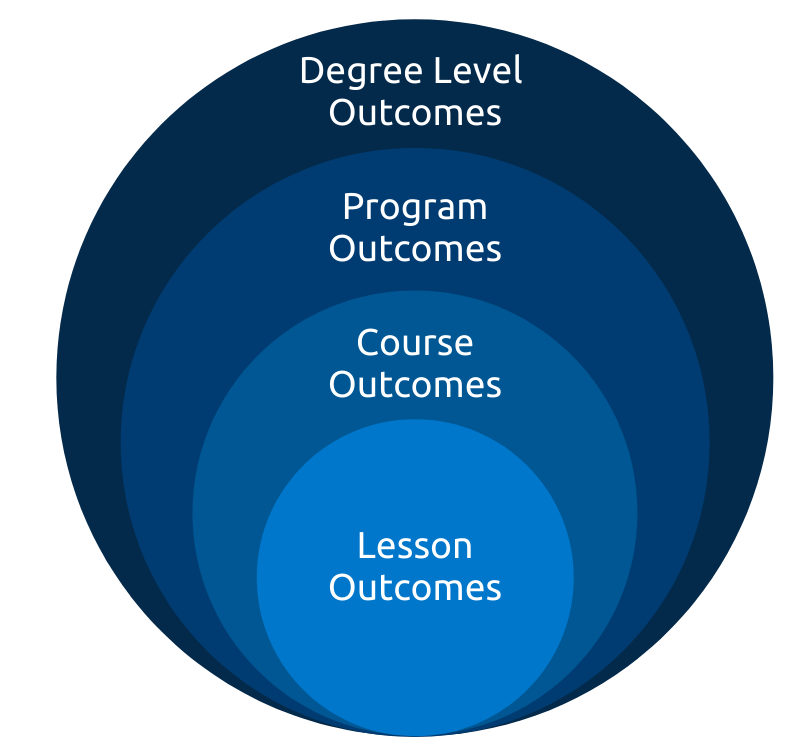
Learning outcomes can exist at multiple levels, including lesson, module, course, program, and degree levels. In learner-centred instructional design, outcomes play an important role in creating alignment across the learning experience. Assessments, instructional activities, resources, and feedback opportunities should all support learners in achieving the intended outcomes.
Writing Effective Learning Outcomes
Effective learning outcomes are learner-focused, measurable, and clearly communicated. They describe what learners should know, value, or be able to demonstrate by the end of a learning experience.
A common structure for writing learning outcomes is:
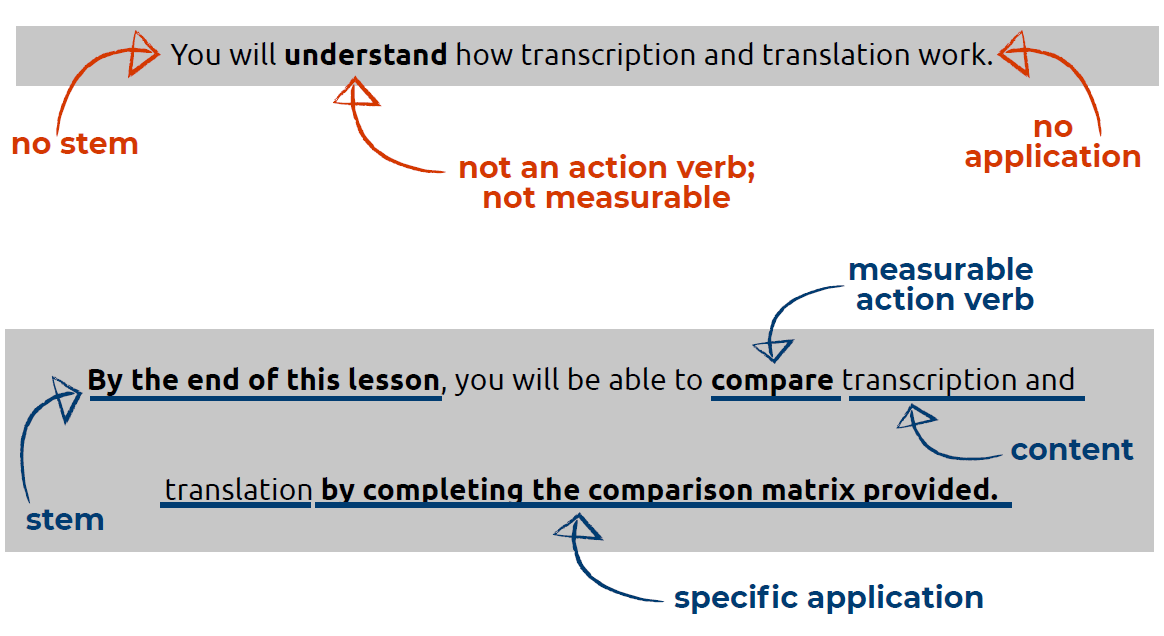
By the end of this [course/module/lesson/activity], you will be able to [action verb] [specific learning] [context/application].
Strong learning outcomes typically include four key elements:
1. The Stem
A statement introducing the intended learning. For example: By the end of this [course/module/lesson/activity], you will be able to…
2. The Action Verb
A measurable verb describing what learners will demonstrate. Action verbs are often informed by Bloom's Taxonomy and may reflect different levels of cognitive complexity such as remembering, understanding, applying, analyzing, evaluating, and creating.
3. The Demonstrated Learning
The specific knowledge, skill, or value learners will demonstrate.
4. The Context or Application
The conditions, tools, setting, or context in which the learning will be demonstrated.
Example
Best Practices
- Use learner-focused language
- Use measurable action verbs
- Avoid vague or difficult-to-measure verbs such as understand, know, learn, or become familiar with
- Use one action verb per outcome when possible
- Be specific and clear
- Align outcomes with instructional activities and assessments
- Consider a range of cognitive levels rather than focusing only on recall or memorization
Using Bloom's Taxonomy
Bloom's taxonomy refers to a framework to categorize educational goals. It was first developed by Benjamin Bloom and colleagues in 1956 and consisted of six categories: knowledge, comprehension, application, analysis, synthesis and evaluation. In 2001, Anderson and Krathwohl revised Bloom's taxonomy, making some structural changes and replacing the nouns in Bloom's categories with verbs.
The revised version of Bloom's taxonomy summarizes the process of learning, from lower order skills like remembering and understanding to higher order skills like evaluating and creating. You can use Bloom's taxonomy table to identify action verbs that align with each learning level. You can then incorporate these measurable verbs into learning outcomes to clearly indicate what the student must do to demonstrate learning.
Examples
The examples below align with each learning level in Bloom's taxonomy.
Remember: By the end of this unit, you will be able to label the 14 facial bones on a diagram.
Understand: By the end of this lesson, you will be able to compare historic and modern treaty negotiations in a Venn diagram.
Apply: By the end of this course, you will be able to solve algebraic equations using real-life examples.
Analyze: By the end of this course, you will be able to analyze restorative justice practices in case study examples.
Evaluate: By the end of this lesson, you will be able to test for the presence of protein in five food samples using the virtual Biuret's test simulator.
Create: By the end of this unit, you will be able to compose a research-based five paragraph essay based on a topic of your choice.
References
Bloom, B. S., Engelhart, M. D., Furst, E. J., Hill, W. H., & Krathwohl, D. R. (1956). Taxonomy of Educational Objectives, Handbook 1: Cognitive Domain. David McKay Company, Inc.
Krathwohl, D. R. (2002). A Revision of Bloom’s Taxonomy: An Overview. Theory into Practice, 41(4).